Suzanne Bianchetti. Now here's a name many aspiring French actresses dream of as it is the name of an award given each year to the most promising one by the
Société des auteurs et compositeurs dramatiques, the society which manages collective right management for authors in France. The original idea was to give it to any deserving actor, male or female, with at least two films on his resume. In fact, only once was it given to a man, Roger Dumas, in 1959.
This year, Camille Cottin, most famous for her role of La connasse, won the coveted award.
Do you know who Suzanne Bianchetti was, though? The award was created by her husband, film historian René Jeanne (partly responsible for the Cannes festival as well) when she died at the early age of 47.
Born February 24, 1889 in Paris, Suzanne is supported by her family to do what she pleases so she learns to sing and act and her performances are sometimes the object of newspaper articles: in June 1910, her performance in musical adaptations by Esclavy at the salon of Mlle L. Popelin was apparently was a great success. In March 1911, it is Mme Ernest Pellerin that invites her and Miss Fajole to read poetry.
In 1913, she marries René Jeanne and from that point on, it would only be a matter of time until she started a career in the movies, as the man was one of the most respected film columnist of the time. As a matter of fact, articles announcing her death even point out that she started a career in films thanks to him even though she always told a different story and attributed that to fate.
Military Film Debut
Her first film is a war effort, still visible on the EPAD website, called
The French woman during the war, made to show the role of women during WWI and directed by Alexandre Devarennes. The film depicts their lives in the city and at the country and the various jobs ordinarily reserved to men that they now master while keeping their mother duties. Suzanne plays the part of the mother left alone to care for her child.
Although various sources list the film as being released during the war, it shows the factory workers who remained at work on January 30, 1918 when there was a bombing. So it had to be shown after that. Suzanne remembered that she was visiting the studios in 1917 as one of her friends from the Comédie française, Andrée de Chauveron, was late and she was asked by M. Devarennes to step in for her. She says she had only done amateur theater up till then and was more scared to shoot that simple scene than to act on the stage.
 |
| Trois familles with Henri Bosc |
Comedy, extra and Melodrama
After this, she appears in 1919 in a few films from the same director. First in another war propaganda movie written by her husband called
Trois familles where she shares the screen with certified stars of the time like Severin-Mars, Emile Drain, Henri Bosc, Berthe Jalabert and Jean Toulout. The film was released in Paris January 24, 1919 and shows "in a documented and often moving fashion, what the relations between France and the United States have been since the beginning of the war. The action takes place in the most beautiful spots of Paris and Tours."
Then she appears in comedies called
Riquette et le nouveau riche and
Riquette et sa mère. In the former, Suzanne brings her own pet dog Crapotte to shoot with her.
 |
| Flipotte et le nouveau riche with Sémery |
In 1919, she shoots her first film for the famous director Jacques de Baroncelli who hires her for what she says were "cameos" alongside the actor Gabriel Signoret and that she learned a lot from him. The comedy is called
Flipotte and is the story of a thief taking the place of a wealthy man away in Australia. In it, she also crosses path with the younger and yet already better known Andrée Brabant.
Henri Desfontaines also hires her for his film
Sa gosse, released November 21, 1919 with Elmire Vautier. Again, her part is not important enough for the critics to notice or mention her. In their November 22, 1919 critic of the film,
Ciné pour tous even mentions that the film seems to have benefited from a small budget.
 |
| Une brute with André Nox |
Comoedia considers Daniel Bompard's
Une brute to be her debut or so it reads in their columns on June 6, 1920, when they announce the film's trade showing. They predict that she will be much noticed. Suzanne, however, considered her part to be over melodramatic for her and the only good memory that remained of it was her friendship with actors André Nox and Jean Signoret.
On November 14, 1920, they also write that she shows "charm and sensitivity" in
La Marseillaise (or
La naissance de la Marseillaise) where she shares the screen with Varny, young actor of the comédie française and M. Allard, a baryton from the opéra comique. The latter plays the Baron who first sang the anthem and she plays his wife. The film was often shown with orchestra and choir that played the famous tune.
 |
| Le rêve with Gabriel Signoret |
As many before her, she plays a pretty second fiddle to the famous comedians of the time. For Humour-Film, she appears in
Agénor, Chevalier sans peur in late 1920 aside Lucien Callamand who codirects with Floury and plays the title role of several Agénor movies of which this is the third. Comoedia notices "the slim and gracious Suzanne Bianchetti".
In early 1921, her roles become more and more important as she appears in
Le rêve by Jacques de Baroncelli again with Andrée Brabant. The same director gives her a part in
Le Père Goriot later that year. When presented with the film on October 4, 1921, Comeodia judges that she could achieve more that what she was asked to do.
She is then offered a part in Léon Poirier's upcoming film
Paris where she is supposed to have a scene on a plane, which she relishes as "the only sport I like". Her 1914 first flight had made quite an impression on her. Unfortunately, the film is cancelled before anything is shot and for Suzanne, the year ends with a film by Pierre Colombier called
Soirée de Réveillon shown appropriately enough during a Christmas show on December 23, 1921.
 |
| Soirée de réveillon with André Clairius & Marguerite Madys |
1922, The Turning Point with Jocelyn and Mysteries of Paris
 |
| Julie in Jocelyn |
 |
| With Anne-Marie Laurent in Jocelyn |
Léon Poirier still wishes to work with her and gives her the part of Julie, the sister of the main character of his next film:
Jocelyn from a poem by Lamartine. Jocelyn sacrifices his own happiness so that her sister Julie can marry the man she loves, as their mother is not wealthy enough to launch them both in the world.
Critics, as soon as June 14, 1922, find her charming and talented and "regret that she was not given more time to show off both qualities" C.F. Tavano from
Le rappel thinks that she's "not enough seen on screen".
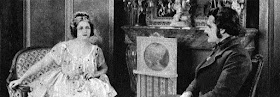 |
| Les mystères de Paris |
This success (the film is still shown in Paris in April and June 1923) gets her the public's attention. She begins receiving fan mail and her next part is in a big production at the Phocéa production company which produces an adaptation of Eugène Sue's famous novel
Les mystères de Paris and director Charles Burguet hires her to play Clémence d'Harville, a marquise opposite one of the most famous actresses of the time,
Huguette Duflos. By the time the film is released on October 6, 1922, Suzanne is now a face to be reckoned with in French cinema.
Cover Girl
 |
| L'affaire du courrier de Lyon with Laurence Myrga |
On November 30, 1922, she is on the cover of
Mon ciné with an interview of the actress in her Paris home, located 6 rue d'Aumale (she apparently later moved rue chaptal in the same neighborhood), with her cat Pacha and her new dog Vulcain (Crapotte died of the flu earlier). In it, she recollects her debut and the film she has just finished:
L'affaire du courrier de Lyon, a three episode saga with a prologue, again by Léon Poirier where she also happily worked again with Myrga and Roger Karl. That film even inspired painter Raymond Pallier who painted her in that role for a portrait. But she stays silent as to her next project.
It so happens that two major directors, Baroncelli and Abel Gance, both want to shoot a movie about the same subject. Comoedia announces on December 20, 1922 that Baroncelli is done shooting his exterior for "
Beatrix" in Belgium and will start filming at the studio of Epinay with Sandra Milowanoff in the title role, Eric Barclay and "the charming Suzanne Bianchetti". By early 1923, Gance apparently renounced his own project.
The film is announced as finished on March 9, 1923, shown to the press in April and released under the title
La légende de soeur Béatrix in 1923. By that time,
L'affaire du courrier de Lyon is finally released on March 9, 1923 (one episode at a time) and provides ample press coverage for the young star.
 |
| Violettes impériales |
Violettes Imperiales, the first Royal part
On May 5, 1923, it is announced that she was chosen by Henry Roussell to play in
Violettes Impériales with Raquel Meller and André Roanne. For this film, a few exteriors were made in Spain but most of it was shot indoors at the studio of Epinay. A later article by J.K. Raymond-Millet published in December 1926 tells of his meeting with the actress in Seville when she was making that film. "I learnt that Suzanne Bianchetti is superstitious. 13 brought her luck repeatedly and she is grateful for that. She always wears a pale coral, in the shape of a mask of comedy which she thinks protects her." He also mentions how this film was important for her national and international career as it was distributed accross the world. We also learn that she likes dogs, only not when they bark, that she has grilled roast beef and chocolate for breakfast, that she loves traveling and reads Paul Claudel. Ciné miroir also shares a bit if trivia on December 12, 1923 about the making of the film: after a night of shooting near the Menchen studios at Epinay, the entire cast and crew returned to Paris... and left Suzanne behind. There was no train or automobile to take her so she had to wait for the chauffeur of the limousine to realize his mistake and come back for her.
Even before the press screening of
Violettes Impériales, Jacques de Baroncelli announces on October 4, 1923 yet another film with Sandra Milowanoff and Bianchetti that he penned himself:
Un homme riche that will later become
La flambée des rêves. Right after that, on October 20, it is René Leprince who announces that he has hired her for the part of the blonde villainess Princess Mila Serena in
L'enfant des halles, another eight chapter serial.
 |
| The evil Mila Serena arrested in L'enfant des Halles after shooting PeauDure |
On November 1, it is the Baroncelli movie that Suzanne starts filming with Charles Vanel in the cast and the shoot lasts a little over a month only. On the 13,
Violette impériales is presented to the press at the Marivaux theater and the praise is unanimous: Suzanne hasn't betrayed her prestigious model: Empress Eugénie. It doesn't hurt that among the many critics, the ones for Le petit journal AND Paris soir were written by her husband. But let us be fair: there is hardly a cloud in the sky anyway. Jacques Vivien in
Le petit Parisien writes: "Miss Bianchetti looks a little like the Empress, as she is shown on her portraits, when she was pretty."
On December 28, 1923,
La légende de Soeur Beatrix is released at the Palais Rochechouart in Paris. In his January 13, 1924 review in La rampe, L. Valter writes that "Miss Bianchetti has only a cameo, but she brings much allure and charm."
 |
| L'enfant des halles with Lucien d'Alsace & Francine Mussey |
Serials
 |
| with Gabriel Signoret in L'enfant des Halles |
The first episode of
L'enfant des Halles is presented on February 27, 1924 at the Marivaux and again, the press likes the film and Suzanne's performance, the public follows when the first episode is released April 11, 1924. In La rampe, dated May 4, 1924, L. Valter writes: "Miss Suzanne Bianchetti is a beautiful, seductive and poisonous lady. Even though she inspires more admiraion than fear, the audience will not complain. I will not either."
From early March 1924, Mon ciné magazine also publishes regular accounts of the shoot of
La Brière, from Alphonse de Châteaubriant, where Léon Poirier and his wife Jeanne seem to give a good family atmosphere in the country. Interiors are shot in April at the Gaumont studio. The film is presented in January and released April 24, 1925.
Before that, after a rehearsal on March 20, 1924 (remember that in those days, there was a complete show and a full orchestra for a premiere) accessible with an invitation only,
Violettes Impériales was finally premiered on Friday, March 21, 1924 at the Marivaux.
Both films share the screens of Paris at the same time and Suzanne Bianchetti is all the rage. L. Valter writes on June 29: "Miss Suzanne Bianchetti is now, after a good experience, among the best artists in today's cinema."
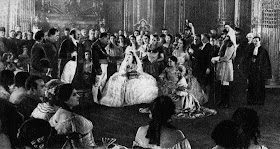 |
| Wedding of Eugénie and Napoléon III in Violettes Impériales |
On July 5, 1924 Cosmograph eventually presents Baroncelli's
Flambée des rêves to the press. The film is released in October of that year and Suzanne plays the part of "The other one" alongside Eric Barclay, Charles Vanel and Sandra Milowanoff. On June 19, 1924, Mon ciné publishes a picture of Suzanne on set "courageously" sweeping the floor of the studio in her silk negligé.
 |
| On set of La flambée des rêves |
An International Empress, Madame Sans-Gene
October is spent at Compiegne and December at the Fontainebleau castle for the shoot of
Madame Sans-Gêne. Suzanne remembers that it was difficult to simulate a nice summer evening watching fireworks on December 12 while it was freezing out. Although she could use the actual bed of the Empress, there was no mattress or blanket. The latter was provided by the director's wife but no mattress could be found and the actress spent a very uncomfortable time shooting the bedroom scene.
Cinéa announces that Suzanne is among the cast of Jacques de Baroncelli's
Veille d'armes. Unfortunately, it seems her part eventually went to British actress Annette Benson.
Then comes Serge Nadedjine's
L'Heureuse mort (previously announced by Cinéa as
La mort heureuse in August 1924) with Nicolas Rimsky on February 13, 1925 which is a "gay film" reviewed by Jacques Vivien in
Le petit parisien in those terms: "Too much macabre is dipped in comedy, but there are good parts in this film where Miss Suzanne Bianchetti quite pleasantly plays".
 |
| Le nègre blanc with Nicolas Rimsky |
Only two days after its release, a second film with these two actors is announced by the Albatros company:
Le nègre blanc. One must remember that the N word was socially acceptable in film titles long after that in France (and indeed many other countries). In March newspapers announce that Serge Nadejdine, the director is replaced for an undisclosed reason by Henry Wulschleberg, and eventually Rimsky becomes the main director. Exteriors were shot in Nice and in May, the Apollo theater was used for the first time in a film for a scene where Rimsky conducts an orchestra and Suzanne sings (of course they both pretended for the camera). The film is presented by Les films Armor at the Artistic Cinéma on September 12, 1925 and, unusually for he time, released right after that on September 18. Simone Brive writes in
Le Rappel that "Suzanne Bianchetti so pretty, so subtle, would have deserved to be called a star long ago, if French cinema, like its wealthy American colleague, created such a thing".
 |
| France's top stars (Eve Francis,Jean Toulout, Suzanne Talba, etc.) Suzanne is the 4th from right, second row. |
In the meantime, Suzanne Bianchetti remains socially active and attends many premieres, dinners, with her husband: she is seen at Mogador for the Paris premiere of
Monsieur Beaucaire starring Rudolph Valentino on February 26, 1925. In April, she is one of the many stars selling programs for The Enchanted Night, a show produced by M. Sabatier, president of the party comity of Paris which also attracted Andrée Brabant, Eve Francis, Huguette Duflos, Gina Relly, Charles de Rochefort (known as Charles de Roche in the US)... On April 23, she attends a dinner with her husband organized by Michel Carré for artists and distributors... and even the funeral of director Robert Saidreau on December 9 even though the two never actually worked together. Also in 1925, she is again the subject of a portrait painted by Cipria and exposed at the salon in April of that year.
In May of 1925, articles about the American version of the Gloria Swanson vehicle shot in France
Madame Sans-Gêne by Léonce Perret start to spread: the film is beautiful and it promises to be even better in France without the cuts made to suit the American tastes. However thanks to this version, Suzanne Bianchetti is now seen in a major motion picture in the USA in another part of a sovereign: Empress Marie-Louise. Even with a complete feature as it is premiered on December 16, 1925 at the Paris Opera (the first showings on the 15 are the two rehearsals), critics regret that Gloria Swanson is given too much screen time compared to Emile Drain or Suzanne who only appear "when the absolute necessity of their roles demands it". As a matter of fact, in her memoirs, Suzanne reveals that she was mugged in her 5cv on her way home from Compiegne: while a friend of hers was driving, they were assaulted by three men who were later caught and trialed but even though the actress badly cut her hand on broken glass, she went on fiming with gloves and was told not to publicize the event as publicity surrounding the film was contractually obliged to be solely about Gloria Swanson.
 |
| Les aventures de Robert Macaire with Jean Angelo |
The Adventures of Robert Macaire
 |
| Louise de Sermèze in Robert Macaire |
She is then announced in May 26, 1925 as the major female part in Jean Epstein's next 5 episode serial for Albatros:
Un amour de Robert Macaire, a title changed a month later to
Les aventures de Robert Macaire with Jean Angelo. Exteriors are shot in Grenoble in the summer of 1925 and studio work begins in September and ends in mid-November. The press screening takes place on December 4, 1925. Of her performance, the director says that she managed to link, in a complex role, a nobility of attitude and a passion that seemed impossible to merge. The first episode is released on December 11 and theaters offer each subsequent episode every week. A condensed version (under 3,000 m) was edited by Jean Epstein himself in March but the complete film has been preserved and is even
available on DVD, though part of a rather pricey box set containing other Jean Epstein films.
The Max Linder theater obtains from Mappemonde films the exclusivity from November 10, 1925 for Marcel Silver's
La ronde de nuit starring Raquel Meller as Stéfania and Suzanne Bianchetti as Princess Hedwige. The general release occurs March 19, 1926.
Napoleon's Marie Antoinette
On January 21, 1926, she attends the opening of the new studio des Ursulines. On May 28, Raymond Villette calls her "the most noble of our movie artists" in Le gaulois.
Her recent record of royal parts (
Madame Sans-Gêne is still in theaters) gets her the coveted role of Marie Antoinette in Abel Gance's legendary
Napoléon, as announced on June 5, 1926. As a matter of fact, Suzanne reveals that she was intended to play the part of Eugenie again, but that part was meant to be shot at a later date so Gance asked her to play the Queen instead. And the role was shortened to a single scene depicting the August 10 events, which she very much regretted as this was one of her favorite historical character. She remembers that the child who played Louis XVII wouldn't look afraid in spite of the scene demanding it and everyone in the crew trying to achieve that result. He eventually yelled: "I won't be afraid! I just don't want to! I have a delicate stomach and it gives me the runs." If you are curious about that scene, or more importantly if you want to experience the entire movie, it is coming on
Blu-ray in October.
 |
Marie Antoinette in Napoleon |
Casanova
Later that year, she plays a fourth sovereign: Catherine II of Russia in Alexandre Volkoff's
Casanova produced by Ciné Alliance and distributed by La société des Cinéromans - Films de France in 1927. This film was to be the last one that the Russian actor Ivan Mosjoukine was supposed to shoot in France before his departure for the USA. Shooting went on until December 1926 ad his last day was a sad one for all the crew who, like him, were Russian emigrants. The press saw it at L'Empire theater on June 22, 1927 as well as the models of the costumes used in the film on display in the hall. Suzanne's performance is judged as "perfect". It wasn't that easy though: Volkoff wanted to achieve an effect of grandeur when the Empress came in and had a velvet coat made with a heavy 22 yard train which forced Suzanne to wear a leather corset so she could carry its weight during the 13 takes that it took to get the scene in the can.
 |
| Casanova with Ivan Mozzhukhin |
It is released exclusively at the Marivaux "with French and English subtitles" (=intertitles) and a stencil-colored Carnival sequence in September 13 and goes on general release on December 23. Although the film was not properly cared for after its initial release, restoration work was achieved in the 1980s from footage of both the negatives made for the French versions and all other foreign versions as well as a positive of the color sequence. The result is sadly not available on home video.
This string of roles inspire her to publish "When I was an Empress" in August 1927 at Les lectures pour Tous.
In February 1927, she is among the personnalities who signed a petition to support Charles Chaplin, recently accused of bigamy. On January 9, 1928, she attends the funeral of fellow actress Claude France who committed suicide.
Verdun, Visions of History
 |
| Verdun, visions d'Histoire |
For her next film, Suzanne starts a trip to Germany, and then shoots the interiors in February at the Gaumont studio with Léon Poirier (who previously even went to Berlin) and the cast and crew then return on location in France to shoot
Verdun, visions d'Histoire. This movie remains, to this day, on of the best films about WWI as many soldiers were asked to play themselves and some of the on-set pictures were even mistakenly used as the genuine thing in History books. The director jokingly said that his main problem on the film was to find young men that still bore a mustache as the current trade was to shave them. The trade showing takes place on November 7, 1918 so that the release date can symbolically occur on November 11, 1928. As mentioned most actors are not professional ones except for a few stars like Suzanne who basically do cameos. The film is
available on DVD.
On April 23, 1928, she begins shooting
Embrassez-moi, a comedy by Robert Péguy at the Epinay studios. However Péguy falls ill and Max de Rieux fills in for him for the first weeks, faithfully following his script. The press can see the film on September 26, 1928 at the Folies Wagram and the film is finally released on February 8, 1929. Among the critics, one can read in
Le populaire: "Suzanne Bianchetti has met with personal success. Her reation, very different from those in
Verdun visions d'Histoire and in
Cagliostro, has shown the versatility of her talent and how she adapts to various situations."
On May 5, 1928, Le gaulois announces that the famous director Maurice Tourneur will direct his version of
Capitaine Fracasse, assisted by
Henry Wulschleger, and Suzanne Bianchetti is, along with Pierre Blanchar and Mendaille among the proposed cast. Although the film was made with some of the announced artists, neither Maurice Tourneur, nor Suzanne were eventually part of them.
 |
| Marie Antoinette in Cagliostro |
A New Marie Antoinette for Cagliostro
From November 4, 1928, until January 5, 1929, Suzanne reprises her role of Marie Antoinette in
Cagliostro at the studio Natan, rue Francoeur and at Epinay with Austrian director Richard Oswald. This time no exteriors are needed and the 40 Italian settings were entirely recreated in the studios, which some critics will regret, as well as its slow pacing when they saw the film on May 22, 1929. The public release was at the Palais Rochechouart July 4 1930.
A picure of the actress appears in Pour Vous magazine on December 20, 1928.
An article in L'écho d'Alger reveals that : "Miss Suzanne Bianchetti appears just enough to leave regrets. A few scenes in color do not improve the bad lighting, or the dark atmospheres so appreciated in Germany and now favored in the USA even though they tire our eyes when not necessary." Nowadays, a restored version of
Cagliostro is available on DVD. Unfortunately, almost half of the film is lost as the main source for the restoration is the Pathé-baby edit augmented with remaining censored scenes in Sweden and other copies.
Suzanne in Germany
In January, she goes to Berlin to film a small role in
Der Mann der nicht liebt, or "
Théâtre" as it is mentioned in the French press, an adaptation of Kean by Alexandre Dumas with Suzanne Delmas, Colette Darfeuil and a German cast. When the German trade screening is related in the press on June 17, 1929, it is supposedly a success but when the French press screening is announced by M.B. Films at the Empire theater for July 9, it is retitled
L'éternelle idole. French critics appreciate it too, even though Suzanne, as the Duchess of Rogall, has a very small part.
 |
| Suzanne and the cast ad crew of Der Mann der nicht Liebt (L'éternelle idole) |
In March 1929, she leaves for Nice for a new part and on June 10, 1929, the press can see Robert Péguy's
Les mufles from Eugène Barbier's novel. Although critics point out a few plot holes, Suzanne Bianchetti is considered "excellent through and through". Cinéa even singles her out among an otherwise "so-so" cast. The Omnia theater has the exclusivity of the film from July 12 to 18 and Le populaire writes "In this film, Suzanne Bianchetti fills with her usual authority a part that is completely different from her previous creations." Indeed, she plays the part of a fickle wife driving her husband to bankruptcy and leaving him for the first banker that comes her way. Quite different from her royal parts.
It went on general release on November 15 1929.
 |
| Les mufles |
Talking pictures
The talking picture looms its ugly head around the corner and as soon as
1928 Comoedia asks the actress what she thinks of it: to her, it is a
step backwards in that it deprives a film of its international quality
and she's afraid that filmgoers cannot keep their attention focused on
the image if they must listen to a dialog, much in the way that a music
lover will close their eyes to listen to it. In August of 1929, when
The
Jazz Singer and many other American talking pictures are screened
throughout the capital, she still thinks that the silent art will be
discovered again soon but also that the talking picture will evolve
rapidly.
 |
| In Guitry's play Histoires de France |
Perhaps in an effort to prepare herself for speaking parts, she agrees to return to the stage at the théâtre Pigalle for 120 performances of the play by Sacha Guitry,
Histoires de France. She's on known territory as she plays the Empress Eugénie, as in
Violettes impériales. Jean Tarride shot a small documentary during the rehearsals of the play in September of 1929 and the premiere was supposed to be filmed as well.
Early in 1930, the American talkies that flooded the screens are progressively upstaged by French speaking movies. However, no studio in France is yet properly equipped to shoot such films. So movies like
Parade d'amour with Maurice Chevalier were actually shot in Hollywood and
La nuit est à nous was shot in Germany with French speaking actors, sometimes with an accent. French movie stars were expected to travel if they wanted the audience to know what they sounded like.
Comoedia announces on March 14, 1930 that actor Pierre Juvenet took the Nord-Express to Berlin to shoot
Le Roi de Paris with Mary Glory and Suzanne Bianchetti. This is to be Suzanne's first talking picture and she plays the part of an ageing Duchess mixed up with a gigolo. She's back by April to shoot another talkie, but in France this time. In his August 15, 1930 critic in
Le Petit Parisien, Jacques Vivien writes: "Ivan Petrovitch, Gabrio, Mary Glory, Suzanne Bianchetti do what they can to enliven this film which is rather mediocre." The audience also resents that a French policeman or a Parisian maid have German accents and the affected Argentinian accent of the main characters also triggers unwanted laughters among the crowd. (Comoedia August 2 1930).
 |
| Princes de la cravache with Michèle Wagner |
By late April, early May, exteriors begin in Chantilly for
Princes de la cravache directed by Marcel L. Wion on the race tracks with famous jockeys of the time: Bedeloup, Loiseau, Niaudot, Bonaventure, and Wion himself. Hebdo film details that several versions in different languages are prepared.
Back to Verdun
On October 12, 1931, the Compagnie universelle cinématographie offers a press screening of a talkie version of
Verdun, visions d'Histoire retitled
Verdun, souvenirs d'Histoire. After only 3 years, the novelty of sound was deemed a good enough reason to recut, partly re-shoot and re-release the film. In this short period of time, the visions became souvenirs. Sound was added to many scenes of the previous film that were re-used and new scenes of dialog were shot early in 1931: a group of children visit Verdun and their school teacher is the narrator of the story. Most of the actual actors from the 1928 version come back in this one and Suzanne has been hired in May to be among them. The film is released in November of that year. The film is also
available on DVD, which is a unique opportunity to compare it with the silent version. In truth, some of the sound effects used in the many battle scenes have an unfortunate comic effect on modern audiences, but the use of sound is not without its merits.
On December 26, 1931, Hebdo Film announces that Léon Poirier has just hired Suzanne Bianchetti for an important part in his next musical production:
La folle nuit, though he only produces it and supervises the direction of a new director on his first film: Robert Bibal. A young Simone Renant begins her career in this light comedy where Suzanne in the part of Clotilde, the governess of the six daughters of a Duchess, can work her usual magic in yet another costume movie. Shooting ends in early February 1932 and the film is shown to the press April 8, 1932. Even if the critics agree that this is a "light show", it remains pleasant and "Suzanne Bianchetti is unique in this type of parts which demand charm and grace". Cinéa, on the other hand, thinks that she is "unremarkable" in this part.
The Living Incarnation of Empress Eugenie
When
La fête impériale, a commemoration of Queen Victoria's visit in Versailles, is organized by Jean le Seyeux in Monte Carlo on February 29, Suzanne Bianchetti is naturally invited to appear as... the Empress with other stars like Noël-Noël.
 |
| Violettes impériales (1932) |
After her silent film and her stage experience as the Empress Eugenie, she was a shoe-in for the talkie remake of the film
Violettes impériales. Suzanne Bianchetti reprises her role in this new version and Georges Peclet replaces André Roanne. Trade show December 12, 1932 Critics consider this script to be more confused that the original. Perhaps in an attempt to make a more international film, French English and Spanish is heard in the dialog at the start of the film and the quality of the recording seems to be another problem that makes dialogs hard to understand at times for some, when others consider it "perfect". It is interesting to notice that the silent version was still touring the country the previous year for an occasional screening: on September 26, 1931, it was shown in Saint Malo.
By September 13, Spanish and Compiegne exteriors are done and the crew is in the Braunberger - Richebé studios in Billancourt.
In early October, Henri Roussell shoots the attack at the town hall of Montmorency and since he thinks the first explosion is not enough, orders a stronger second one which breaks all windows and wakes up the neighbors.
The last week of the shoot, in early October, Henri Roussell settled at night in front of the town hall to shoot the terrorist attack on the Empress. The first explosion was not scary enough but the second one blew up all the windows and woke up many neighbors.
The gala premiere at l'Ermitage taes place on December 12,1932: first a "a charming newsreel about the Comédie française ball", then Raquel Meller herself sings on stage and after the intermission, the main feature is shown to an audience of stars like Harry Baur, Marie Marquet, Ginette D'Yd, Emile Drain, Charles Burguet, etc. Comeodia concludes : "violets will stay in full bloom at the garden of the Emitage."
On December 31, at the Club du Faubourg, Suzanne, with Emile Drain, Georges Péclet and Robert Dartois, participate in a "debate about cinema and History: critic of the film
Violettes impériales".
 |
| Violettes impériales (1932) with Raquel Meller |
About
Violettes impériales, Le populaire writes on December 23, 1932
: "It is a dramatic piece made by a skilled aniumator but it was silent. Now that the film is remade, it taks, sings, and does not profit much by that". "Miss Suzanne Bianchetti is sweet, gracious and plays very well."
In Alger éudiant, though, Gaston Martin writes "Suzanne Bianchetti does not seem to be ideal for the talkies: she has too much theater influence."
The Beginning of the End
As a general rule, the films that Suzanne made since the arrival of the talkies are either remakes of previous success which, although generally good, are doomed to be compared unfavorably to their models, especially when they reuse images from them, or nice little movies with no ambition beyond simple entertainment. Even if the actress is almost always singled out as pretty (a challenge for a 40 year old actress often playing young girls in those days), and very competent at the very least, none of these films compare to the glorious masterpieces that she illuminated by her presence in the 1920s.
Her husband René Jeanne is awarded the Légion d'honneur in January of 1933. On Saturday November 18, 1933 Suzanne participates in the Belgian Film Week in Brussels with Madeleine Renaud and Fernand Gravey.
She appears with new stars in the 1935 film
Aux portes de Paris starring Josette Day and Gaby Morlay.
When she does return to the screen, she does it in a friendly environment with people she's accustomed to work with: director Léon Poirier hires her to appear opposite Maurice Schutz, André Nox, Thomy Bourdelle,...

In 1936, she plays a small part in
L'appel du silence. The films tells the story of Charles de Foucaud, an ermit and martyr in the sahara and his friend Laperrine.
René Jeanne and Gaston Chérau also worked on a script to adapt Champi-Tortu with Suzanne in the part of Jeanne Chevalier.
Sudden Departure
But on Tuesday, October 20, 1936 Comoedia sadly announces: "We have known for a few days that she was lost."
Suzanne succombed as she was undergoing surgery.
Three days later, Le petit Parisien also writes an homage.
Her husband and their friends take her to her last resting place at the père Lachaise after a cereony at the Trinité church.
In her 1922 Mon ciné interview, she said that "when I'm really really old, I wish to retire in the country and breed cats and dogs. But it bears repeating: not until I'm really old." Her wish was not fulfilled but, unlike most actresses from that time, her name will remain for many years to come.
Don't forget to click "like" on the
Facebook page for more.
That's all for today, folks!


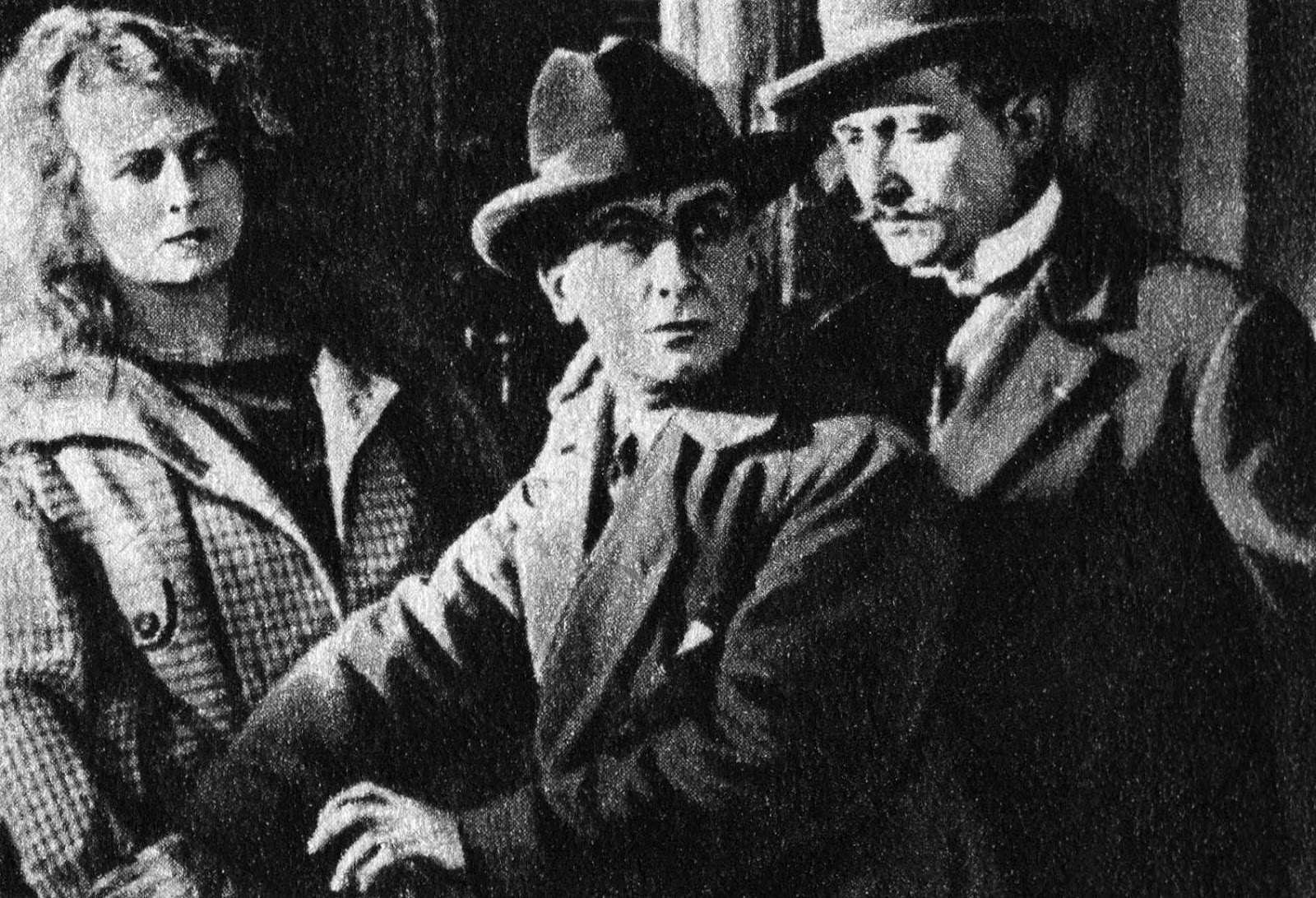


 In 1936, she plays a small part in L'appel du silence. The films tells the story of Charles de Foucaud, an ermit and martyr in the sahara and his friend Laperrine.


 At the
Oxford theater, from August 4, 1917, she plays the part of
Victoire in The Better 'Ole, a musical comedy based on a comics character. The plays lasts until November 23,
1918 but Edmée is replaced halfway by Peggy Foster. She then plays French classics at the Théâtre des
alliés of J. T. Grein, as announced in The Tatler issue of February 6, 1918. Ads announced that she acts at the Duke of York
theater but, again, no titles are given. She is in
1919 film: The odds against her, probably financed by her own money since she has the main part. On November 12, that same year, she appears at the Victory Ball costumed as grape.
At the
Oxford theater, from August 4, 1917, she plays the part of
Victoire in The Better 'Ole, a musical comedy based on a comics character. The plays lasts until November 23,
1918 but Edmée is replaced halfway by Peggy Foster. She then plays French classics at the Théâtre des
alliés of J. T. Grein, as announced in The Tatler issue of February 6, 1918. Ads announced that she acts at the Duke of York
theater but, again, no titles are given. She is in
1919 film: The odds against her, probably financed by her own money since she has the main part. On November 12, that same year, she appears at the Victory Ball costumed as grape.  Mrs.
Owen keeps fooling around with a coroner, and then an Argentinian named Gregorini and she goes to France to live with him at 11 rue
Lesueur in Paris. She decides to become a movie star in her native country the only way she knows how: she gives FF70,000 to an impresario, M. Dante, to get her a starring part in a film. The script, sometimes referred to as The double misunderstanding, is a model of vaudeville comedy hastily assembled to satisfy Edmée's whim by Robert
Saidreau from an already made film, which he naively hoped no one would notice. The script is shot under the title The strange adventure. Once confronted with the refusal of the distributors to release the film,
Edmée demands her money back which she obtains in November 1928 from a court that awards her an extra FF 5,000. One month after that, she appears once again in the papers because she loses a valuable necklace, 1.5 million francs worth. An honest seamstress, Mme
Rejeade, finds it at La Madeleine church and brings it back to her, therefore earning the £560 reward from the insurance company. Edmée wastes millions and her money is melting.
Mrs.
Owen keeps fooling around with a coroner, and then an Argentinian named Gregorini and she goes to France to live with him at 11 rue
Lesueur in Paris. She decides to become a movie star in her native country the only way she knows how: she gives FF70,000 to an impresario, M. Dante, to get her a starring part in a film. The script, sometimes referred to as The double misunderstanding, is a model of vaudeville comedy hastily assembled to satisfy Edmée's whim by Robert
Saidreau from an already made film, which he naively hoped no one would notice. The script is shot under the title The strange adventure. Once confronted with the refusal of the distributors to release the film,
Edmée demands her money back which she obtains in November 1928 from a court that awards her an extra FF 5,000. One month after that, she appears once again in the papers because she loses a valuable necklace, 1.5 million francs worth. An honest seamstress, Mme
Rejeade, finds it at La Madeleine church and brings it back to her, therefore earning the £560 reward from the insurance company. Edmée wastes millions and her money is melting.


 After less than three years, she gets out of the Haguenau prison, where she had been transferred, on March 14 1933, and after a short stay in Paris, she goes back to London to look for "peace and forgetfulness" as the newspaper put it. It seems that it was too boring a plan as she reappears on September in Paris from Bulgaria and announces that she intends to become a plane pilot.
